
The North Louisiana Landowner’s Guide to Fixing Washed-Out Gravel Roads After Winter
4/16/2026
North Louisiana winters can be mild compared to the rest of the country, but the season still brings hazardous weather. While snowfall is rare, rainfall can be relentless, and clay-heavy soils don't drain as well as sandy ground. This can turn your gravel farm road into a rutted, eroded mess. The good news is that once the storm clears and the ground dries out, you can get your road back in shape yourself. All you need is the right equipment and a solid game plan. Here's how to repair a washed-out gravel road in North Louisiana, step by step.
A compact utility tractor is the ideal machine for rural road maintenance: powerful enough to move material efficiently, maneuverable enough to work a narrow private road or driveway. For this job, you'll want something in the 25–55 HP range. The John Deere 2 Series (up to 38 HP) and 3 Series (32–46 HP) are both well-suited for gravel road repair. Look for a model with 4WD for better traction on soft, uneven post-rain ground, and iMatch™ Quick-Hitch compatibility to make switching implements fast and simple.
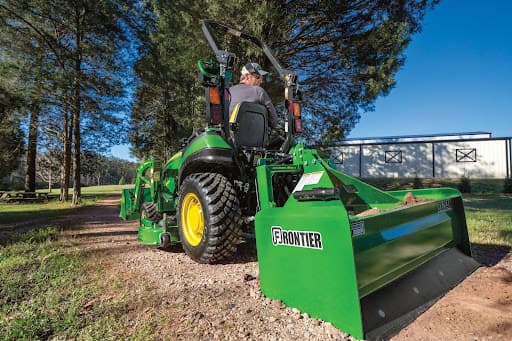
The box blade is the go-to implement for gravel road repair. It's built for grading and leveling, and its scarifier teeth are what set it apart. The teeth break up compacted gravel and hardpan so material can be redistributed where it belongs, rather than just pushed to the side. The Frontier BB2072 offers a 72-inch working width and 19 cubic feet of capacity, while the BB2084 steps up to an 84-inch working width for wider roads or longer stretches. Both are iMatch™ compatible and rated up to 55 HP, with five replaceable scarifier shanks, three depth adjustment positions, and reversible cutting edges built to handle tough Louisiana conditions.
No matter how eager you are to fix your driveway after a rough season, this is a step you don’t want to skip — which can be challenging for some North Louisiana homeowners. Louisiana clay soils, common across Union, Richland, Morehouse, and Madison parishes, hold water long after the rain stops. If you fire up the tractor too soon, you'll push mud instead of gravel, and you'll end up with a worse mess than you started with.
Before you get to work, walk the road first. Look for standing water and check whether your boots sink more than an inch into the surface. If they do, give it another day or two. You want the ground firm and workable. Ensure your ground is damp enough to grade smoothly, but dry enough to hold its shape once you’re done.
Pro tip: Check the forecast before you start. You want 3–5 dry days ahead to let your work set properly.
Before you can reshape anything, you need to break up what's there. Lower the scarifier teeth on the Frontier box blade to their deepest setting and make a slow pass down the length of the road. The shanks will break up hardpack and loosen displaced gravel that has migrated toward the edges. This step mixes the existing material so it can be graded back into the roadbed, working with what you already have before bringing in anything new.
Keep your tractor speed slow and steady throughout this pass. Let the shanks do the work.
With the scarifier raised, switch to using the cutting edges to collect loose gravel and pull it back toward the center of the road. Work from the outside edges inward, making overlapping passes. The fixed back plate and tailgate on the Frontier BB20 help contain material in the box so gravel ends up where you want it and not scattered behind the blade.
As you go, fill in ruts and potholes by releasing material from the box in the low spots. Step off the tractor periodically to walk the road and check your progress. It's easy to miss shallow dips from the seat.
How long your repair lasts will depend on this crucial step. A properly crowned road sheds water to the ditches instead of letting it pool on the surface and erode the base. Without a crown, even a well-repaired road will wash out again with the next heavy rain — and in North Louisiana, that's never far off.
To build the crown, angle the box blade slightly upward toward the center of the road and make several passes, gradually building material up toward the high point. A good benchmark: raise the center roughly 2–3 inches for every 10 feet of road width, creating a gentle 2–4% slope from center to edge. It doesn't take much, just enough to keep water moving off the surface and into the ditch.
A road or pathway with poor drainage is a mess waiting to happen. Once the surface is graded and crowned, check both sides for clogged or collapsed roadside ditches. Use the box blade to clean out shallow ditches by pulling material away from the road edge and down into the low area. If culverts are present, make sure they're clear of debris. A blocked culvert is one of the fastest ways to cause a washout. The scarifier teeth can also be used to open a shallow drainage swale along the road edge if needed.
Even after thorough regrading, most roads will need a topdressing of fresh gravel to replace material lost to erosion. Crushed limestone is a popular choice in Louisiana — it packs well and holds up to clay soil. Apply it evenly with a dump truck or trailer, then use the box blade to spread and smooth it out. Finish with one final light pass using the cutting edges only (no scarifying) to level the surface and lock in that crown you worked to build.
Repairing a washed-out gravel road involves six key steps: waiting for the ground to dry completely, scarifying and loosening the surface with a box blade, regrading and reshaping the roadbed, building a proper crown, clearing drainage ditches and culverts, and topdressing with fresh gravel. Using a compact tractor with a box blade attachment makes the job manageable for most rural property owners.
A compact utility tractor in the 25–55 HP range, paired with a box blade, is the most effective setup for private gravel road repair. The John Deere 2 Series (up to 38 HP) and 3 Series (32–46 HP) compact tractors work well for most driveways and farm roads. The Frontier BB2072 (72-inch working width) or BB2084 (84-inch working width) box blades are both popular choices — their scarifier teeth break up hard-packed material, and their reversible cutting edges redistribute gravel efficiently
Working on wet ground with a box blade pushes mud rather than moving gravel, which can leave you with a worse surface than you started with. Louisiana clay soils — common across Union, Richland, Morehouse, and Madison parishes — hold moisture long after rain stops. A good rule of thumb: if your boots sink more than an inch into the road surface, wait another day or two. Aim for at least 3–5 dry days in the forecast before you begin so the finished road has time to set properly.
In Louisiana, gravel road maintenance is a recurring task rather than a one-time repair. The combination of clay-heavy soils, heavy rainfall, and high humidity means roads degrade faster than in drier climates. Most rural property owners in North Louisiana plan for at least one significant regrading per year — typically after winter rains — with spot maintenance after major weather events throughout the season.
Goldman Equipment carries John Deere compact tractors and Frontier implements across 11 locations in North and Central Louisiana, including Farmerville, Rayville, Winnsboro, Tallulah, West Monroe, Natchitoches, and Alexandria. Their team can help match you to the right tractor and box blade for your property, and John Deere Financial options are available to help spread the cost.
Gravel road repair isn't a one-and-done job in Louisiana. With the clay soil and wet climate, you'll be back at it season after season. The right equipment makes it manageable. A John Deere compact tractor paired with a Frontier box blade gives you a reliable, versatile setup that handles road maintenance and plenty of other property tasks year-round.
Ready to put together the right setup for your land? Stop by any of Goldman Equipment's North Louisiana locations — including Farmerville, Rayville, Winnsboro, and Tallulah — and talk it over with a team that knows Louisiana property inside and out. Ask about the full Frontier box blade lineup and current financing options on John Deere compact tractors.