
Cotton’s Coming: How North Louisiana Farmers Are Prepping Ground Before It’s Too Late
4/16/2026
Cotton is big business in Louisiana, and planting season is just around the corner. From mid-April to mid-May is when the first seeds drop, but the clock starts ticking long before then. In North Louisiana, farmers don't have the luxury of waiting around. Spring rains, wet clay soils, and unpredictable weather make the prep window tight. A successful season starts with ground that's ready when the time is right, and getting there takes the right equipment lineup to move your fields from "too wet to touch" to "ready to plant."
North Louisiana's clay-heavy soils compact over winter and don't drain quickly after spring rains, which means there's a fine line between ground that’s too wet and too dry to work well.
To determine if your soil is in good condition for planting, you can monitor your soil temperature. According to the LSU AgCenter, optimal conditions for cotton germination are present when soil temperature at the 4-inch depth reaches 65°F or greater at 8 a.m. for at least three consecutive days, with a favorable five-day forecast following planting. Well-tilled, loose soil warms faster than compacted ground — meaning good ground prep doesn't just get the seedbed ready, it actively moves your planting date forward.
Farmers in parishes like Richland, Tensas, Madison, and Morehouse are also dealing with heavy residue from last year's crop that needs to be worked in before the planter rolls. The sooner that process starts, the more options you have when the weather cooperates.
Getting your ground ready for cotton typically requires a couple of passes and the right machines for each one. Having the right equipment is crucial for success.
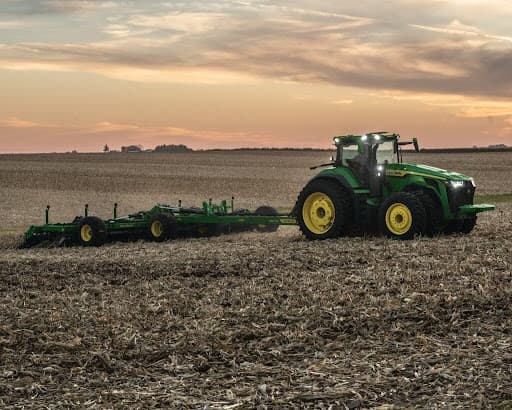
Every implement on this list needs something capable of pulling it, and the John Deere 8R is the workhorse built for that job. The 8R and 8RX tractors combine power, technology, and maneuverability, making them well-suited for heavy pre-plant tillage work across large Louisiana row crop operations. The current lineup runs from 230 horsepower up to 540 rated horsepower — and with the optional Peak Power Intelligent Power Management (IPM) system, these tractors can unlock up to 634 horsepower when conditions demand it. The Electric Variable Transmission (EVT) delivers efficient power to the ground and integrates seamlessly with precision ag technology, helping operators maintain productivity even when field conditions are changing fast.
Best for: Large-acre cotton operations in North Louisiana running 30–65 ft tillage implements.
Primary tillage is all about breaking up compacted soil and getting last season's crop residue worked into the ground. The John Deere 2680H High-Performance Disk is built to do exactly that — and to do it quickly. This two-season tool can operate at speeds up to 14 mph in the field and is available in 15 configurations from 8 ft to 45 ft, so there's a fit for operations of any size.
What makes the 2680H particularly well-suited for Louisiana conditions is how it handles variable soil. The individually mounted blades are supported by rubber torsion elements that allow each blade to travel up to 9 inches when it hits an obstruction, keeping the rest of the tool engaged and working without skipping a section. Integrated TruSet Tillage technology lets operators adjust depth on the go from the cab. This is critical when soil conditions shift from one end of a bottomland field to the other.
Louisiana note: The rubber roller rear attachment is a strong choice for spring seedbed work, helping firm the soil surface and anchor residue in lighter soils heading into planting.
Best for: Primary tillage pass, residue incorporation, breaking winter-compacted ground.
Once the disk pass is done, the field cultivator is what creates the final seedbed before the planter comes through. The John Deere 2230 uses even 6-inch split-the-middle shank spacing to minimize the chance of weed strips surviving the tillage pass. A field cultivator pass made just prior to planting gives the crop the best chance to emerge into a weed-free environment and reach canopy ahead of the competition.
The TruPosition C-shanks deliver 200 lbs of trip force to minimize side-to-side movement and provide better control of the soil profile — keeping depth consistent and reducing streaks even at higher working speeds. The ProFinish Leveling System rounds out the package with multiple rear harrow options to fine-tune the seedbed finish based on what the field needs.
Louisiana note: A uniform, level seedbed is especially important in Louisiana's clay soils, which can crust and seal between rain events. Getting this pass right can make a real difference in emergence uniformity.
Best for: Pre-plant seedbed finishing, weed management ahead of planting, and leveling uneven ground.
Pre-emergent herbicide application is a non-negotiable step in cotton ground prep — and in North Louisiana's compressed spring window, timing is everything. The John Deere R4023 is built for operations where maneuverability and efficiency matter as much as coverage. With a 600-gallon solution tank and boom configurations ranging from 60 ft up to 90 ft, it's well-matched to the smaller, odd-shaped fields common across North Louisiana's broken bottomland and upland acres. The 82-gallon fuel tank supports up to 16 hours of spraying without stopping to refuel, which matters when the weather window opens and you need to move.
The R4023 is powered by a 4.5L John Deere PowerTech PSS engine delivering 173 hp — with a 5% power bulge up to 182 hp when conditions push back. The boom folds quickly for headland turns and transport, and the optional BoomTrac Pro automatic boom-height control system helps manage drift and maintain consistent spray accuracy, even on uneven terrain. Wide and narrow axle configurations give operators the flexibility to match row spacing on a field-by-field basis.
Best for: Pre-emergent herbicide application, burndown passes, in-season fertilizer applications.
Spring in North Louisiana is a game of patience and opportunism — wet one week, dry and hard the next. A few guidelines to keep in mind as you plan:
Good cotton starts with good ground preparation — and that preparation starts now. Farmers who get their tillage done early have more options when planting conditions finally align. Those who wait can find themselves rushing through passes on marginal ground, or worse, missing the window altogether.
Ground preparation for cotton in North Louisiana should begin as early in the spring as field conditions allow — ideally, well before the mid-April to mid-May planting window opens. The goal is to have tillage completed and the seedbed ready before soil temperatures reach optimal germination conditions (65°F or greater at the 4-inch depth for at least three consecutive days). Because North Louisiana's clay soils compact over winter and dry out quickly once temperatures rise, farmers who start early have far more flexibility when planting conditions finally align.
Most North Louisiana cotton operations require two to three passes to achieve a proper seedbed. A typical sequence is: (1) a primary disk pass to break compacted soil and incorporate crop residue, (2) a field cultivator pass to create a uniform, level seedbed just ahead of planting, and (3) a sprayer pass to apply pre-emergent herbicide. The right timing between these passes — particularly around spring rain events — is just as important as the passes themselves.
The John Deere 8R Series is the go-to choice for large-acre cotton operations in North Louisiana. The current lineup ranges from 230 to 540 rated horsepower, with Peak Power IPM unlocking up to 634 hp on demand. The 8R's Electric Variable Transmission (EVT) and precision ag integration make it well-suited for pulling wide tillage implements — disk harrows, field cultivators, and more — efficiently across Louisiana's row crop fields. Goldman Equipment carries the 8R Series at locations in Rayville, Tallulah, West Monroe, Winnsboro, Farmerville, and more.
Pre-emergent herbicide is typically applied in the same window as the final tillage pass — as close to planting as practical. The goal is to protect the freshly prepared seedbed without allowing weed pressure to establish before the cotton emerges. In North Louisiana's spring weather, where planting windows open and close quickly between rain events, having a self-propelled sprayer like the John Deere R4023 ready to move means you can hit that window without delay.
Yes. Goldman Equipment is an authorized John Deere dealer with 11 locations across North and Central Louisiana, including Rayville, Tallulah, West Monroe, Winnsboro, Farmerville, Natchitoches, Bossier City, Alexandria, and more. Their factory-trained technicians can help with equipment selection, pre-season service, and parts for tractors, disk harrows, field cultivators, and sprayers. Stop by your nearest location or visit goldmanequip.com to learn more.
Ready to get your equipment lineup set for cotton season? Stop by your nearest Goldman Equipment location in Rayville, Tallulah, West Monroe, Winnsboro, Farmerville, or any of our 11 locations across North and Central Louisiana. Our team can help you find the right John Deere equipment to make the most of your planting window.