
Cotton Is Waist High and the Pivot Is Running. Is Your John Deere Sprayer Calibrated for Mid-Season?
8/5/2026
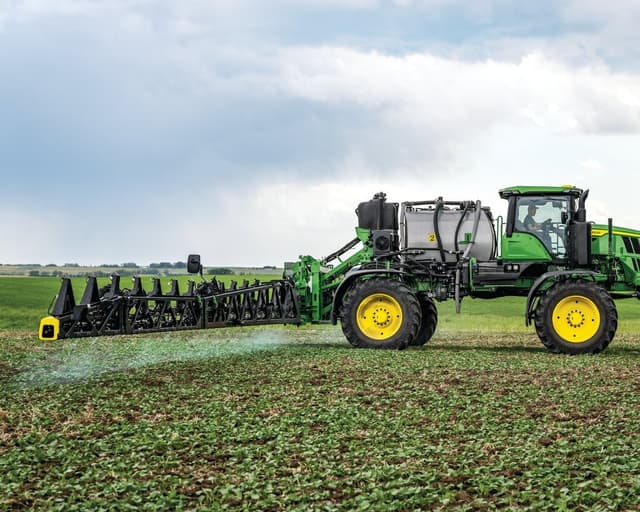
Recalibrating mid-season is how you make sure the product you paid for actually lands where the crop needs it. Here is how to check your John Deere sprayer now, while the crop still has time to respond.
Why Sprayer Calibration Drifts During the Season
Calibration is not a one-and-done job. Three things change between planting and mid-season, and all three pull your application rate off target.
None of these show up as a breakdown. They show up as skips, streaks, or a spray bill that does not match the results you are seeing in the field.
When Should You Recalibrate Your Cotton Sprayer?
At a minimum, recalibrate once per season. Beyond that, run through it whenever you change nozzles, target speed, or operating pressure. Mid-season is one of those natural checkpoints, especially before your first post-bloom plant bug application when coverage matters most.
A good habit is to check your nozzle tips a couple of times per season rather than waiting for a problem. If you are running the sprayer hard on cotton, corn, and beans, the tips can wear faster than you would expect.
How to Check Your John Deere Sprayer Nozzles for Wear
How to Calculate Your Target Gallons Per Acre
Before you fine-tune, you need three numbers: your target gallons per acre (GPA), your ground speed in miles per hour (MPH), and your nozzle spacing in inches. From there, you can find the gallons per minute each nozzle needs to deliver:
GPM per nozzle = (MPH × GPA × nozzle spacing in inches) ÷ 5,940
Once you know the GPM each nozzle should be putting out, you can compare it to what your tips are actually delivering and adjust pressure, speed, or tip size to close the gap.
Step-by-Step: Calibrating Your John Deere Sprayer Mid-Season
With the walk-around done and your target numbers in hand, work through it in order:
Getting Coverage Right When Plant Bugs Move In
This is exactly why the mid-season calibration check matters more on cotton than almost any other crop. When you are making a post-bloom application into a thick, waist-high canopy, accurate output and the right droplet size are what carry the product down into the plant.
Keep Your Application on Target This Season
Frequently Asked Questions
How often should I calibrate my cotton sprayer?
At least once per season, plus any time you change nozzles, ground speed, or operating pressure. Checking your tips a couple of times per season is a good habit when you are running the machine hard.
What is an acceptable nozzle output variance?
Replace any nozzle that is more than 10 percent off its rated catalog output. Overall, the sprayer is considered calibrated when measured output is within about 5 percent of your target rate.
How do I calculate gallons per acre for my sprayer?
Use (MPH × GPA × nozzle spacing in inches) ÷ 5,940 to find the gallons per minute each nozzle should deliver, then compare that to what your tips actually put out.
Do I still need to calibrate a John Deere sprayer with ExactApply?
Yes. Rate control systems adjust to hit a target, but they still rely on good nozzle tips and clean screens. Worn tips and clogged strainers will pull you off rate no matter what the controller is set to.